
UAH insights and updates
TL;DR
Blockchain is more than cryptocurrency. Its ability to securely record and share transactions has applications across finance, healthcare, law, and education. Leading universities are introducing blockchain courses across disciplines, opening new learning and career opportunities for students.
Beyond Bitcoin: The Power of Blockchain
If you know any young person or even read the newspapers, you would have heard about cryptocurrency and the promise of quick wealth by investing in Bitcoin or Ripple – the two most famous of the thousands of cryptocurrencies and digital assets in the world, along with a healthy dose of debate on their merits, with everybody from the Governments to the big banks weighing in with their opinions.
While these currencies represent a new form of “value storage”, the real attraction for a large number of people is the technology on which it is based – blockchain.
How Does Blockchain Technology Work?
Wikipedia describes blockchain as a decentralized, distributed, public digital ledger used to record transactions across many computers, so the blockchain is generally tamper-resistant without altering all subsequent blocks and without the network's consensus. This means that it is a system that is managed autonomously by the participants in the system based on certain rules and does not need a centralized agency to impose these. In other words, it democratizes the process of administration and brings in a certain level of transparency, which allows the cost of transactions to be lowered. Therefore, any industry that involves records and settlement of any kind between multiple parties can be technically disrupted by this technology – finance, insurance, legal contracts, education, healthcare, etc.
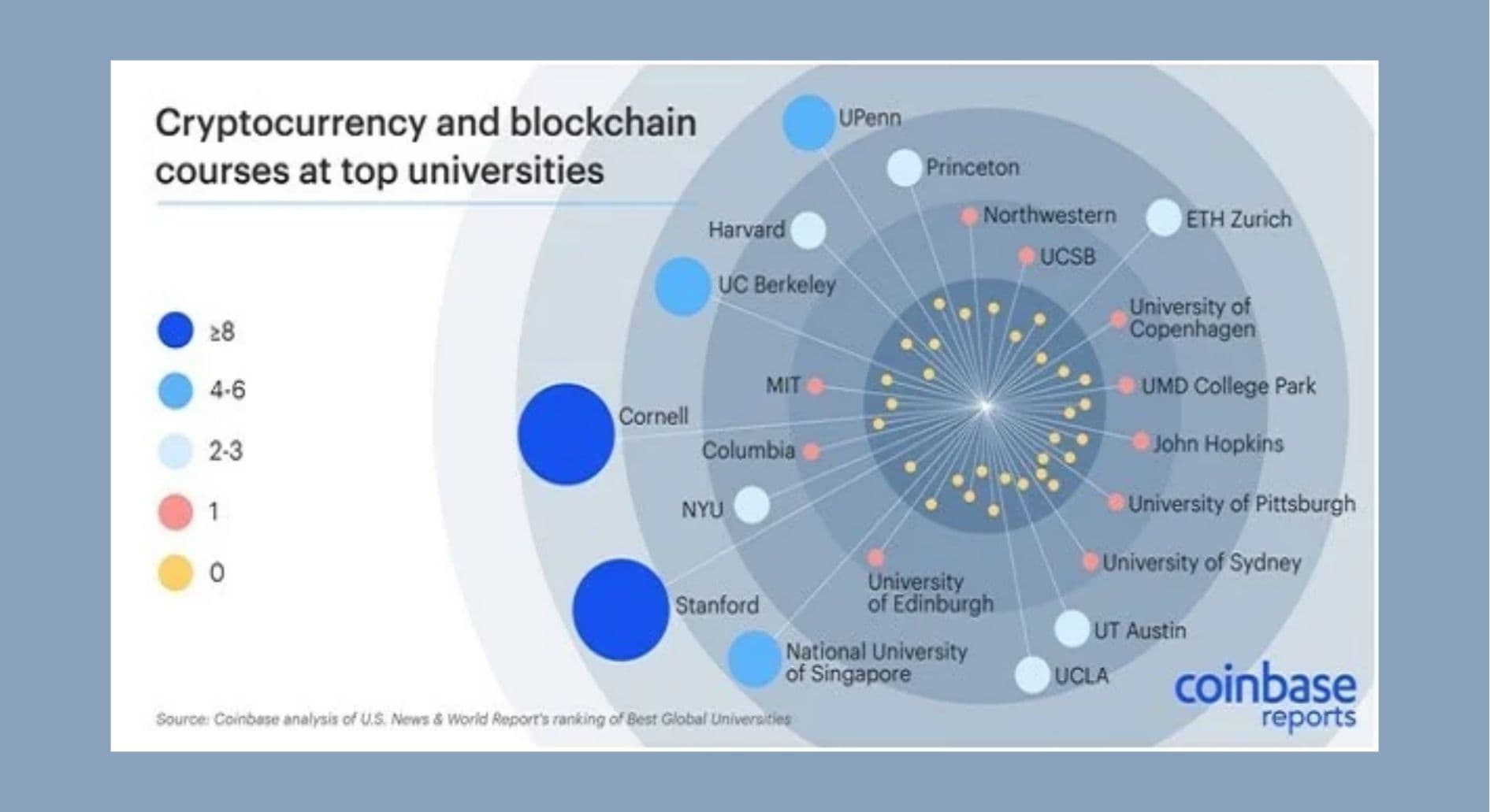
The good thing is that the top institutes have taken note of the potential of this technology, and as per a recent survey commissioned by Coinbase (the leading exchange to trade all manners of cryptocurrencies), almost 56% of the world’s top 50 universities have started offering courses related to this technology. And this is interdisciplinary – computer science, business, and law departments have already started offering courses related to blockchain and cryptocurrencies. This is a great example of the universities responding quickly to technology changes and allowing students to explore in preparation for future roles in this domain.
Universities to Study Blockchain
The illustrative list of 5 universities where students are looking to study cryptocurrencies is -:
| No. | University |
|---|---|
| 1. | National University of Singapore |
| 2. | Royal Melbourne Institute of Technology |
| 3. | University of California, Berkeley |
| 4. | University of Zurich |
| 5. | Massachusetts Institute of Technology |
Key Takeaways
- Blockchain goes beyond Bitcoin: Blockchain is the technology behind cryptocurrencies, with applications across multiple industries.
- Decentralization is its key strength: Blockchain enables participants to maintain shared records without relying on a single central authority.
- Blockchain has applications across industries: Finance, insurance, healthcare, education, and legal services can use blockchain to improve transparency and record management.
- Blockchain is an interdisciplinary subject: Students from computer science, finance, business, and law can explore its applications.
- Blockchain offers new career pathways: Students can explore blockchain development, cybersecurity, smart contracts, digital finance, and related research fields.
Frequently asked questions
Blockchain is a shared digital ledger that records transactions across a network of computers. Cryptography and consensus mechanisms help keep records secure, transparent, and difficult to change.
Blockchain is the underlying technology, while cryptocurrency is one of its applications. Bitcoin uses blockchain to record transactions, but blockchain can also support digital contracts, financial services, and record verification.
Yes. Blockchain is an interdisciplinary field. Students studying business, finance, economics, law, and computer science can explore blockchain applications through university courses, electives, and research projects.
Blockchain skills can support careers in software development, cybersecurity, fintech, smart contract development, blockchain research, and digital asset compliance. Career opportunities depend on technical skills, industry knowledge, and practical experience.
Related Blog Posts



Our services
Here is where to go next — learn about our services





The application is yours. The guidance is ours.
UAH’s founders will tell you honestly what you need — even if the answer isn’t us.
A free 30-minute diagnostic call. No commitment.