
UAH insights and updates

TL;DR
Digital banks like Monzo and Revolut are transforming banking careers. AI, automation, and fintech are changing traditional roles, creating demand for skills in coding, data analytics, critical thinking, and collaboration. Future bankers must combine financial knowledge with technology.
How Digital Banks Are Changing Banking Careers
Take a look at the image below with all the recent job postings from Monzo. Founded in 2015 by British entrepreneur Tom Blomfield and his co-founders, Monzo has grown into one of the UK's leading digital banks. Operating primarily through its mobile app without traditional branches, Monzo now serves over 16 million customers and employs more than 5,000 people. Its annual revenue reached £1.7 billion in FY2026. Having expanded into Ireland and Spain, Monzo continues to demonstrate how technology is transforming traditional banking.
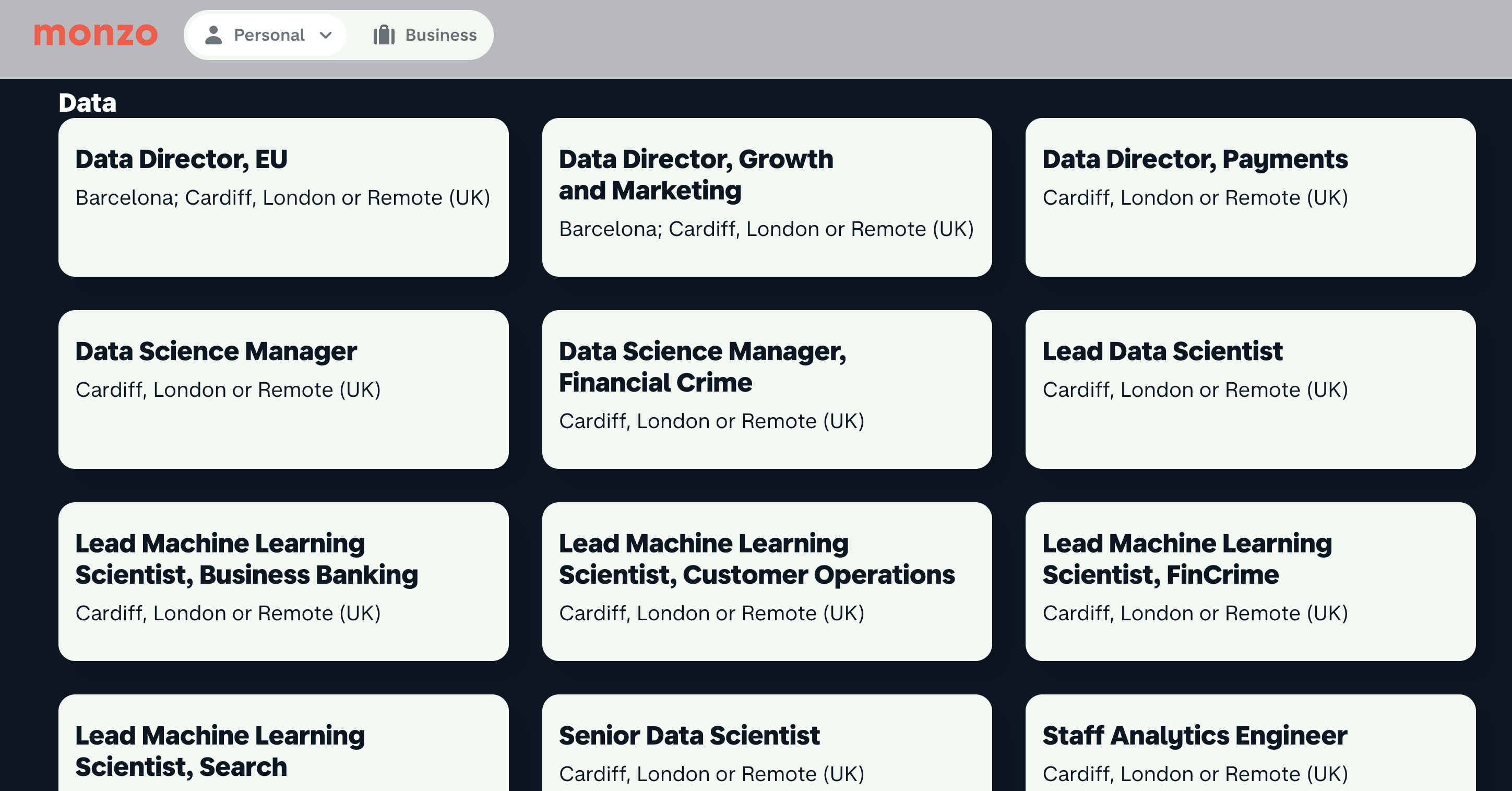
The reason I mention Monzo is to highlight the changed face of banking and, therefore, the changed description of jobs now available in a bank. Move over MBAs, Chartered Accountants, and Chartered Financial Analysts. Future bankers need a new set of skills, including the ability to code, to operate large datasets, scale rapidly worldwide, while having the mindset to work collaboratively with cross-functional teams with diverse cultures and skill sets in a global workforce.
If you want to dismiss this as a one-off case, the rise of other similar banks like Revolut, Starling Bank and Atom Bank suggests that this is a trend that is here to stay and is likely to fundamentally change banking. The Virgin Group, a GBP 5.5 billion conglomerate, is also investing heavily in a similar bank called Virgin Money, to be launched in 2019.
How AI and Automation Are Transforming Banking
A McKinsey report on “The transformative power of automation in banking” highlighted several use cases
for automation in the industry – JPMorgan using bots to respond to internal IT requests, Fukoku Mutual Life of Japan using IBM’s Watson (AI program) to settle insurance claims, and ANZ automating the mortgage payments process and semi-annual audit report generation. It is expected that 10-25% of the jobs in a bank will become automated in the next 10 years, while the employees would focus on more value-added roles.
All these examples clearly showcase that traditional roles in the banking segment are under threat, and anyone not willing to build a new set of skills that include the ability to think critically, communicate, and work collaboratively with teams, transcending cultural and functional differences, is going to find themselves redundant very soon.
Today, the transformation of banking has accelerated with generative AI, digital payments, and automated financial services. Banks are increasingly using AI for customer support, fraud detection, risk assessment, and compliance. For students planning careers in banking, the message is clear: finance knowledge alone may not be enough. Combining financial expertise with technology, data analytics, and human skills will create broader career opportunities.
Key Takeaways
- Digital banking is transforming the industry: Fintech companies like Monzo, Revolut, and Starling Bank are changing how customers access financial services.
- Traditional banking roles are evolving: AI and automation are handling routine tasks, increasing the importance of analytical, technical, and customer-focused skills.
- Technology skills offer a competitive advantage: Coding, data analytics, AI, cybersecurity, and digital product development are increasingly valuable in banking careers.
- Human skills remain essential: Critical thinking, communication, collaboration, and adaptability help professionals work effectively across teams and technologies.
Frequently asked questions
AI is automating tasks such as customer support, fraud detection, document processing, and compliance checks. Banking professionals increasingly need data analysis, technological literacy, problem-solving, and risk-management skills.
Future banking careers require financial knowledge alongside AI, data analytics, programming, cybersecurity, and digital technology skills. Communication, critical thinking, adaptability, and teamwork are equally important.
An MBA or finance degree provides a useful foundation, but fintech employers may also value programming, data analysis, digital product management, and AI skills. The requirements depend on the role and employer.
Students can pursue finance, computer science, economics, data science, business analytics, or financial technology. Combining financial knowledge with practical technology skills can prepare them for careers in digital banking and fintech.
Related Blog Posts



Our services
Here is where to go next — learn about our services





The application is yours. The guidance is ours.
UAH’s founders will tell you honestly what you need — even if the answer isn’t us.
A free 30-minute diagnostic call. No commitment.